My Villager bus to Nottingham this morning was half-full when I boarded, which was unusual because it's normally around a third full when I board in the mid/late morning but there were still plenty of seats left. As my bus continued its way through the town, it rapidly filled and before it reached the main stop, it had reached its carrying capacity and the driver had no choice but to drive past people wanting a ride.
I was in an aisle seat from the start and before the bus reached the town's main stop, the man next to me indicated that he wanted to move. I thought he wanted to get off the bus; as such, I moved out of the way and moved into where he was sitting before, as is the standard practice. Unfortunately for me, he wasn't departing: he had moved so others could sit in his place and, by extension, mine.
As such, when I realised this I immediately felt rude and like a douche. While I'm sure the man did not intend to guilt-trip me into moving so others could sit down, his actions had that exact effect and when the main stop arrived, I departed the bus right there and then - even though it was within the same town - rather than face an uncomfortable ride to Nottingham with the feeling of "sitting where I wasn't supposed to and knowing it". I do not know if anyone thought I had been rude but my leaving the bus meant others could sit down, which negated any accidental rudeness on my part, as far as I am concerned.
It could be argued that my leaving was cowardice on my part and that I should have surrendered the seat and stood; however, it could also be argued that I did not violate any rules and that I was fully entitled to move to the window seat after thinking the man wanted to leave. After all, the people who were standing directly next to me, while being significantly older, were not in desperate need of seats and no one else was bothering to give up theirs. At any rate, my leaving freed up space on the bus, so it could also be argued that I was willing to catch a later bus just for someone else's comfort, even if I was pressured into it.
I have offered to give my seat to others before but people rarely accept such offers unless they are truly in need of sitting.
Showing posts with label Society. Show all posts
Showing posts with label Society. Show all posts
Tuesday, 1 December 2015


Tuesday, 25 March 2014
Uneven level of attractiveness
I discovered this article this morning and found it extremely interesting:
It's about a man who won a radio station's "Punching Above Your Weight Champion" award, which he won for being in a relationship where the woman is massively more attractive than the man. Darren Donaghey, the man in said type of relationship, self-nominated for the award after hearing about it on the radio on the way to work one day. The radio station's listeners voted Donaghey and his fiancée, Kate Cathart, as the winners.
While Cathart and Donaghey's relationship is viewed as unusual, it shouldn't be. When I walk around my residence and when I've been to other parts of this country, it's not uncommon for me to see couples where one half is far more attractive than the other...and it's not soley beautiful woman-ugly man relationships, either! I've observed quite a few couples that would cause many people to ask "what's that [insert positive appearance adjective here] man doing with her?" Evidently, the people in these relationships didn't consider looks and money to be determining factors, as with Cathart and Donaghey. In the end, so what if they're both not on the same level of attractiveness? As long as they love each other and are happy, that's all that counts. Nobody's approval is necessary and any offence certain people might take is irrelevant; as the adage goes, beauty is in the eye of the beholder.
I like relationships such as Cathart and Donaghey's because they break the social construct that people should be of equal or similar attractiveness to be in a relationship with each other. They also help to disprove the false notion pushed by some men that most women are only interested in a man if he's hot or rich (or both). It gets boring reading comments from men who dismiss all women as gold diggers and dismiss people like Cathart and Donaghey as an anomaly or a distraction.
I also like Cathart and Donaghey's sense of humour. The fact they are able to laugh about themselves and their relationship shows good character on their part. I wish them the best of luck for their marriage.
It's about a man who won a radio station's "Punching Above Your Weight Champion" award, which he won for being in a relationship where the woman is massively more attractive than the man. Darren Donaghey, the man in said type of relationship, self-nominated for the award after hearing about it on the radio on the way to work one day. The radio station's listeners voted Donaghey and his fiancée, Kate Cathart, as the winners.
While Cathart and Donaghey's relationship is viewed as unusual, it shouldn't be. When I walk around my residence and when I've been to other parts of this country, it's not uncommon for me to see couples where one half is far more attractive than the other...and it's not soley beautiful woman-ugly man relationships, either! I've observed quite a few couples that would cause many people to ask "what's that [insert positive appearance adjective here] man doing with her?" Evidently, the people in these relationships didn't consider looks and money to be determining factors, as with Cathart and Donaghey. In the end, so what if they're both not on the same level of attractiveness? As long as they love each other and are happy, that's all that counts. Nobody's approval is necessary and any offence certain people might take is irrelevant; as the adage goes, beauty is in the eye of the beholder.
I like relationships such as Cathart and Donaghey's because they break the social construct that people should be of equal or similar attractiveness to be in a relationship with each other. They also help to disprove the false notion pushed by some men that most women are only interested in a man if he's hot or rich (or both). It gets boring reading comments from men who dismiss all women as gold diggers and dismiss people like Cathart and Donaghey as an anomaly or a distraction.
I also like Cathart and Donaghey's sense of humour. The fact they are able to laugh about themselves and their relationship shows good character on their part. I wish them the best of luck for their marriage.
Friday, 14 March 2014
Men buying women's hygiene products
I've read in some feminist forums comments from women expressing frustration about their boyfriends or husbands refusing to buy feminine hygiene products. In those same discussions, I've also read some women say that they wouldn't date or would dump a man who wouldn't buy these items for them. I can understand these women's perspectives, but I have to ask this: just why are the men embarrassed to buy feminine hygiene products? What is their problem?
If a man is worried about being mocked for buying feminine hygiene products, he should view it this way: the mere fact he is buying these items indicates that there is an important woman in his life, who is his romantic partner, and that he is a good man for getting these things for her. He is trusted by her to get her what she needs for her body, for issues that he doesn't have to worry about in regards to his own body.
If a man is worried about being viewed as less masculine for buying them, then first, he's being immature and irrationally sensitive. Second: If people see a man buying such items, the vast majority of them will either think nothing of it or assume that he's a caring man in a loving relationship, not a weak excuse for a "man" who is controlled by his wife. Sure, there will be the occasional jerk who'll mock him, but so what? That person, regardless of gender, isn't mature enough to be in a relationship, whereas the good man is.
If a man is uncaring and disrespectful of a woman's reproductive system and women's issues, and thus regards women's hygiene as something that's beneath him, then he is a sexist and needs to grow up. Preferably sooner rather than later.
Additionally, I would argue that men who purchase pornographic magazines or similar items should feel far, far more embarrassed than men who buy their girlfriends' or wives' hygiene products. A man who buys these is likely to be viewed negatively, as people would assume he thinks that women are objects for his pleasure, rather than his fellow human beings. They also might think that he's the undateable type, hence his reliance on pornography.
I asked Dad his opinion on this topic. He shrugged, saying that he'd bought Mum her feminine products before and felt no shame in doing so. As he said, why would he? It's nothing shameful. He also thought that men who wouldn't buy them, for whatever reason, were insecure and idiots, and he agreed with me that it would be more embarrassing to be buying naughty magazines.
Oh, and one other thing: there's also the possibility that a man buying women's products could be a dad getting them for his teenage (or even adult) daughter, which would make him a great father, not a laughingstock. Honestly, there's nothing here that men need to be embarrassed about.
If a man is worried about being mocked for buying feminine hygiene products, he should view it this way: the mere fact he is buying these items indicates that there is an important woman in his life, who is his romantic partner, and that he is a good man for getting these things for her. He is trusted by her to get her what she needs for her body, for issues that he doesn't have to worry about in regards to his own body.
If a man is worried about being viewed as less masculine for buying them, then first, he's being immature and irrationally sensitive. Second: If people see a man buying such items, the vast majority of them will either think nothing of it or assume that he's a caring man in a loving relationship, not a weak excuse for a "man" who is controlled by his wife. Sure, there will be the occasional jerk who'll mock him, but so what? That person, regardless of gender, isn't mature enough to be in a relationship, whereas the good man is.
If a man is uncaring and disrespectful of a woman's reproductive system and women's issues, and thus regards women's hygiene as something that's beneath him, then he is a sexist and needs to grow up. Preferably sooner rather than later.
Additionally, I would argue that men who purchase pornographic magazines or similar items should feel far, far more embarrassed than men who buy their girlfriends' or wives' hygiene products. A man who buys these is likely to be viewed negatively, as people would assume he thinks that women are objects for his pleasure, rather than his fellow human beings. They also might think that he's the undateable type, hence his reliance on pornography.
I asked Dad his opinion on this topic. He shrugged, saying that he'd bought Mum her feminine products before and felt no shame in doing so. As he said, why would he? It's nothing shameful. He also thought that men who wouldn't buy them, for whatever reason, were insecure and idiots, and he agreed with me that it would be more embarrassing to be buying naughty magazines.
Oh, and one other thing: there's also the possibility that a man buying women's products could be a dad getting them for his teenage (or even adult) daughter, which would make him a great father, not a laughingstock. Honestly, there's nothing here that men need to be embarrassed about.
Saturday, 8 March 2014
International Women's Day 2014
Today is International Women's Day. On most normal days, I usually come across or notice multiple articles about women's issues but surprisingly, I've seen very few of them today. I have, however, seen several people wish "Happy International Women's Day" to others.
This is all very well, but International Women's Day exists to recognise the progress of women's rights and women's achievements, and to raise awareness about women's issues and how we can solve them. While I am glad to see people mention the day and cause others to notice it, I'm not overly keen on randomly greeting people with it, as I feel it trivialises its importance and reduces it to the level of people wishing one another a Happy Halloween.
International Women's Day is also meant to be a celebration of women, but it's not meant to be a day when we say "Yay, women!" and then go back to sleep. There are 364 (sometimes 365) other days of the year in which we have to continue to advance women's rights and stop certain people and groups from reversing all the gains women have made in the past century. Again, I'm glad to see people mention the day and help raise its awareness, but don't leave it at that.
As for me, my family and I had a discussion about International Women's Day at the dinner table this evening. This is significant because it's the first time I can recall us ever talking about it; unfortunately, on past 8ths of March (and other days, sadly) the subject did not come up in conversation, although to be fair, we weren't even aware it existed until about the past three years, so yes, the awareness efforts do need to continue. I'm glad that we talked about it this year.
Regardless, I hope that you have had a Happy International Women's Day and have contributed somehow - even in a tiny manner - to improving women's lives.
This is all very well, but International Women's Day exists to recognise the progress of women's rights and women's achievements, and to raise awareness about women's issues and how we can solve them. While I am glad to see people mention the day and cause others to notice it, I'm not overly keen on randomly greeting people with it, as I feel it trivialises its importance and reduces it to the level of people wishing one another a Happy Halloween.
International Women's Day is also meant to be a celebration of women, but it's not meant to be a day when we say "Yay, women!" and then go back to sleep. There are 364 (sometimes 365) other days of the year in which we have to continue to advance women's rights and stop certain people and groups from reversing all the gains women have made in the past century. Again, I'm glad to see people mention the day and help raise its awareness, but don't leave it at that.
As for me, my family and I had a discussion about International Women's Day at the dinner table this evening. This is significant because it's the first time I can recall us ever talking about it; unfortunately, on past 8ths of March (and other days, sadly) the subject did not come up in conversation, although to be fair, we weren't even aware it existed until about the past three years, so yes, the awareness efforts do need to continue. I'm glad that we talked about it this year.
Regardless, I hope that you have had a Happy International Women's Day and have contributed somehow - even in a tiny manner - to improving women's lives.
Wednesday, 19 February 2014
Photoshopping
Following up on my post about TLC's "Unpretty", which was also about body image issues, I recently saw this video about photoshopping:
It's disappointing that unrealistic expectations of women's looks are still prevalent in today's day and age. Not only do these high expectations put pressure on girls and women to conform to a certain appearance, as shown in the video, but it also indoctrinates men into thinking that women have to look like photoshopped supermodels.
From my point of view, all four women in the video are more attractive in their natural appearances than when they were photoshopped; there's nothing wrong with how any of them look and their supposed "imperfections" are merely parts of who they are. I hope that most men would share my opinion; it would deeply unfortunate for society if most men preferred photoshopped women over how women actually look.
Of course, I don't have any problem whatsoever with women applying make-up to themselves, as a lot of women do it to boost their self-esteem and/or simply because they enjoy doing it, but I wouldn't ever expect a woman to look like a fashion model. No one looks "perfect" and even if they did, it wouldn't be natural.
It's disappointing that unrealistic expectations of women's looks are still prevalent in today's day and age. Not only do these high expectations put pressure on girls and women to conform to a certain appearance, as shown in the video, but it also indoctrinates men into thinking that women have to look like photoshopped supermodels.
From my point of view, all four women in the video are more attractive in their natural appearances than when they were photoshopped; there's nothing wrong with how any of them look and their supposed "imperfections" are merely parts of who they are. I hope that most men would share my opinion; it would deeply unfortunate for society if most men preferred photoshopped women over how women actually look.
Of course, I don't have any problem whatsoever with women applying make-up to themselves, as a lot of women do it to boost their self-esteem and/or simply because they enjoy doing it, but I wouldn't ever expect a woman to look like a fashion model. No one looks "perfect" and even if they did, it wouldn't be natural.
Thursday, 11 April 2013
More bad ways to break up
I have written two posts on douchey ways to end a relationship. Thanks to a segment on the radio today about breaking up, here's my third installment on the subject.
The first way involved someone posting a link to Kelly Clarkson's "Already Gone" on their partner's Facebook profile (I love Kelly Clarkson, but I wouldn't use her to break up with someone). This was a short and deeply unkind split, with unhappy emoticons and unfriending — on and offline — being the consequences. Yes, this is another break up over the Internet, but it's important for reasons that I'll expand upon later.
The second resembled the first in that it used music: it involved a woman singing Taylor Swift's "We Are Never Ever Getting Back Together" down the phone to her boyfriend, thereby ending their relationship. I have a modicum of respect for the creativity of this one, but it was wrong for two reasons: 1. the breakup wasn't done face-to-face, but if he was a jerk then this is irrelevant. 2. "We Are Never Ever Getting Back Together" isn't even about breaking up...it's about not wanting to get back together, hence the name! I do understand the message, though.
I will grant the third one the honour of being clever, but it was still douchey. The person told their partner that their exes were beautiful; the bemused partner asked "Which one?", only to be told "Me!". It was done over the telephone.
The consensus on the segment was that the best method to end a relationship was over the Internet, which angered me. What is it with these people who think breaking up with someone over the Internet is acceptable? I hope in every one of these cases the relationship wasn't serious: I think it would be disgusting and cowardly to end a deep relationship in such a manner. In be fair, the people contacting the programme were all young (in their teens), so I'm hoping it was a case of collective youthful ignorance and that they will all mature.
Coincidentally, "We Are Never Ever Getting Back Together" played at one point while I was writing this.
The first way involved someone posting a link to Kelly Clarkson's "Already Gone" on their partner's Facebook profile (I love Kelly Clarkson, but I wouldn't use her to break up with someone). This was a short and deeply unkind split, with unhappy emoticons and unfriending — on and offline — being the consequences. Yes, this is another break up over the Internet, but it's important for reasons that I'll expand upon later.
The second resembled the first in that it used music: it involved a woman singing Taylor Swift's "We Are Never Ever Getting Back Together" down the phone to her boyfriend, thereby ending their relationship. I have a modicum of respect for the creativity of this one, but it was wrong for two reasons: 1. the breakup wasn't done face-to-face, but if he was a jerk then this is irrelevant. 2. "We Are Never Ever Getting Back Together" isn't even about breaking up...it's about not wanting to get back together, hence the name! I do understand the message, though.
I will grant the third one the honour of being clever, but it was still douchey. The person told their partner that their exes were beautiful; the bemused partner asked "Which one?", only to be told "Me!". It was done over the telephone.
The consensus on the segment was that the best method to end a relationship was over the Internet, which angered me. What is it with these people who think breaking up with someone over the Internet is acceptable? I hope in every one of these cases the relationship wasn't serious: I think it would be disgusting and cowardly to end a deep relationship in such a manner. In be fair, the people contacting the programme were all young (in their teens), so I'm hoping it was a case of collective youthful ignorance and that they will all mature.
Coincidentally, "We Are Never Ever Getting Back Together" played at one point while I was writing this.
Monday, 8 April 2013
Margaret Thatcher
I'm going to keep this short, mainly due to the large amount of current coverage about the death of Baroness and former Prime Minister of the United Kingdom Margaret Thatcher — and because I'm not seeking a discussion over her premiership — but I wanted to post an excerpt from President Barack Obama's tribute to Thatcher:
Regardless of one's politics, it cannot be denied that Thatcher's ascension to Prime Minister was an important milestone for women. While no woman has been Prime Minister since Thatcher, the 2010 election delivered a record number of female MPs to Parliament and more women continue to get involved with politics every day; I think it's only a matter of time before we have another woman as head of government.
"As a grocer’s daughter who rose to become Britain’s first female prime
minister, she stands as an example to our daughters that there is no
glass ceiling that can’t be shattered."
Regardless of one's politics, it cannot be denied that Thatcher's ascension to Prime Minister was an important milestone for women. While no woman has been Prime Minister since Thatcher, the 2010 election delivered a record number of female MPs to Parliament and more women continue to get involved with politics every day; I think it's only a matter of time before we have another woman as head of government.
Friday, 5 April 2013
On apologising
I read this article on the Daily Mail about a University of Queensland study claiming that refusing to apologise boosts a person's sense of self-worth and feeling of empowerment:
I consider studies like this to be disruptive: society is already rude enough as it is, and giving encouragement to uncivil people will only exacerbate the problem. Granted, it's only a small study (228 people) and it is the Daily Mail that is reporting it, but really, the world doesn't need any more arrogant people!
Fortunately, the majority of commenters on the article have dismissed the study, with the minuscule sample size being the primary reason for its rejection. Multiple people also thought that there are enough rude types around and/or had no interest in being friends or family with someone who has zero regard for the feelings of others; in my own experience, most people I've met would rather apologise for a wrongdoing than ignore what others think to strengthen their own self-importance.
If I make a mistake that requires an apology, I apologise. I don't receive any sort of satisfaction from refusing to give an apology; in fact, I feel awful when I haven't been able to give an apology to somebody when one was clearly required. On the other hand, I don't apologise excessively so that apologising becomes meaningless, but I'd rather have respect for someone else's feelings than be a jerk.
I consider studies like this to be disruptive: society is already rude enough as it is, and giving encouragement to uncivil people will only exacerbate the problem. Granted, it's only a small study (228 people) and it is the Daily Mail that is reporting it, but really, the world doesn't need any more arrogant people!
Fortunately, the majority of commenters on the article have dismissed the study, with the minuscule sample size being the primary reason for its rejection. Multiple people also thought that there are enough rude types around and/or had no interest in being friends or family with someone who has zero regard for the feelings of others; in my own experience, most people I've met would rather apologise for a wrongdoing than ignore what others think to strengthen their own self-importance.
If I make a mistake that requires an apology, I apologise. I don't receive any sort of satisfaction from refusing to give an apology; in fact, I feel awful when I haven't been able to give an apology to somebody when one was clearly required. On the other hand, I don't apologise excessively so that apologising becomes meaningless, but I'd rather have respect for someone else's feelings than be a jerk.
Friday, 29 March 2013
On marriage equality
I promised to write a post about my opinions on marriage equality for gays and lesbians. With last month's vote in Parliament to legalise it and all the current activity in the United States over the issue, now seems a fitting time.
I am a strong supporter of marriage; I doubt this will come as a surprise to my family, friends and followers, but in short: yes, I support marriage equality. I hold no animosity towards gays and lesbians, and have no reason to deny them something I have the right to myself. I am entitled to marry a woman I love and vice versa (with each other's consent, of course), so why should the LGBT people I know, and others who love someone of their own gender, not be allowed to marry?
I do not consider gay marriage to be a threat to my future marriage or to anyone else's, nor do I think heterosexual marriage would be devalued by it. After all, in the United Kingdom and United States, on average a heterosexual marriage has a 50% chance of succeeding, greater amounts of straight people are becoming disinterested in marriage and certain celebrities treat marriage frivolously. None of these problems are caused by gays and lesbians, and marriage equality will not exacerbate them.
I reject arguments against gay marriage such as "it will lead to bestiality and paedophilia!", "gays will force straights into marrying them!" and "people will want to marry their kitchen sink!". Marriage is between two consenting adults who (usually) understand what they're doing. The sole result from legalising gay marriage will be couples of the same gender being allowed to marry; nothing more, nothing less. Everything else is paranoia and utter nonsense.
I don't believe in opposing gay marriage based on politics, either: LGBT people can be liberals, moderates, conservatives or even apolitical — my family and I once had a gay friend and neighbor who identified as a Republican, and his partner was a Democrat! I think it's wonderful that both the President of the United States and the Prime Minister of the United Kingdom — a Democrat and a Conservative, respectively — support equal marrying rights; never before has this happened, and ten years ago this would have been unthinkable.
It's also been stated that gays and lesbians should not be allowed to marry because marriage is only for producing children. If that were the case, then people who are old or infertile should be barred from marrying, and couples whose children have left home and can support themselves should divorce since their marriages have served their purpose. What about all those children born out of wedlock today, too? While on the subject of LGBT parenting, by extension of my support for marriage equality, I support same-sex couples being able to have and raise children; I might not know of many kids raised by gay couples, but I have yet to discover anyone who went off the rails because their parents were both of the same gender.
Nothing will be lost by granting marriage equality. I find it relieving that in this era of falling marriage rates, at least one group of people thinks marriage is worth fighting for. Who knows? Perhaps after gays and lesbians achieve the right to marry, other people might start valuing marriage again! I like to see the positives, and I think marriage equality will be a great step forward in civil rights, respect...and for marriage itself.
I am a strong supporter of marriage; I doubt this will come as a surprise to my family, friends and followers, but in short: yes, I support marriage equality. I hold no animosity towards gays and lesbians, and have no reason to deny them something I have the right to myself. I am entitled to marry a woman I love and vice versa (with each other's consent, of course), so why should the LGBT people I know, and others who love someone of their own gender, not be allowed to marry?
I do not consider gay marriage to be a threat to my future marriage or to anyone else's, nor do I think heterosexual marriage would be devalued by it. After all, in the United Kingdom and United States, on average a heterosexual marriage has a 50% chance of succeeding, greater amounts of straight people are becoming disinterested in marriage and certain celebrities treat marriage frivolously. None of these problems are caused by gays and lesbians, and marriage equality will not exacerbate them.
I reject arguments against gay marriage such as "it will lead to bestiality and paedophilia!", "gays will force straights into marrying them!" and "people will want to marry their kitchen sink!". Marriage is between two consenting adults who (usually) understand what they're doing. The sole result from legalising gay marriage will be couples of the same gender being allowed to marry; nothing more, nothing less. Everything else is paranoia and utter nonsense.
I don't believe in opposing gay marriage based on politics, either: LGBT people can be liberals, moderates, conservatives or even apolitical — my family and I once had a gay friend and neighbor who identified as a Republican, and his partner was a Democrat! I think it's wonderful that both the President of the United States and the Prime Minister of the United Kingdom — a Democrat and a Conservative, respectively — support equal marrying rights; never before has this happened, and ten years ago this would have been unthinkable.
It's also been stated that gays and lesbians should not be allowed to marry because marriage is only for producing children. If that were the case, then people who are old or infertile should be barred from marrying, and couples whose children have left home and can support themselves should divorce since their marriages have served their purpose. What about all those children born out of wedlock today, too? While on the subject of LGBT parenting, by extension of my support for marriage equality, I support same-sex couples being able to have and raise children; I might not know of many kids raised by gay couples, but I have yet to discover anyone who went off the rails because their parents were both of the same gender.
Nothing will be lost by granting marriage equality. I find it relieving that in this era of falling marriage rates, at least one group of people thinks marriage is worth fighting for. Who knows? Perhaps after gays and lesbians achieve the right to marry, other people might start valuing marriage again! I like to see the positives, and I think marriage equality will be a great step forward in civil rights, respect...and for marriage itself.
Sunday, 24 February 2013
Tall women
I have read personal stories from tall women about some of their dating troubles. A common* complaint by these women is how the men they wish to date are either intimidated by them or somehow "feel less manly" in their presence. I find the behaviour of such men bizarre and, more accurately, sexist.
Whenever I have been in the presence of a woman equal to me* in height or taller, I have never felt any hostility or fear towards her for being a tall woman. I've met plenty of people — men and women — taller than I am. Have they ever made me nervous? Certainly...back when I was I child, but even then I considered a tall person's gender irrelevant.
I think that many men who are freaked out by tall women are misogynists. The only reason a man could feel uncomfortable around a tall woman is because he perceives her to be a threat to his self-given "authority" or ability to bully her into conceding an argument to him by using his size advantage as a weapon. Any man who believes this or thinks that a tall woman would reduce his masculinity cannot be considered a man: he is a coward.
Even if he isn't a misogynist, a man of average or above average height bothered by tall women should put everything into perspective: how does a short woman feel when she has to interact with a man who is at least a foot higher than her? If the man intended to cause her harm it is unlikely she would be unable to stop him, but when it comes to a man and a woman of equal height, in most cases the man would still be physically stronger than the woman. Therefore, a man has no reason to feel insecure or threatened by tall women.
For the ultimate question, would I go out with a woman near my height or taller? My answer: Yes — why not? I'm not intimidated by tall women, I don't have a need or desire to control women or engage in one-upmanship over them (same goes for men) and I would not have any problem with being the shorter person in a relationship. I've observed taller woman/shorter man relationships before and I am happy for the people involved in them.
Men should not be insecure about tall women — or about women in general, for that matter — and nor should they only be romantically interested in shorter women purely to maintain a physical advantage in a relationship. All women, regardless of their stature, are entitled to basic respect.
[1] Some tall women prefer to date even taller men, and thus, limit their dating pool as a result. However, this post exclusively addresses male sexism.
[2] I am six feet tall and have met women taller than this.
Whenever I have been in the presence of a woman equal to me* in height or taller, I have never felt any hostility or fear towards her for being a tall woman. I've met plenty of people — men and women — taller than I am. Have they ever made me nervous? Certainly...back when I was I child, but even then I considered a tall person's gender irrelevant.
I think that many men who are freaked out by tall women are misogynists. The only reason a man could feel uncomfortable around a tall woman is because he perceives her to be a threat to his self-given "authority" or ability to bully her into conceding an argument to him by using his size advantage as a weapon. Any man who believes this or thinks that a tall woman would reduce his masculinity cannot be considered a man: he is a coward.
Even if he isn't a misogynist, a man of average or above average height bothered by tall women should put everything into perspective: how does a short woman feel when she has to interact with a man who is at least a foot higher than her? If the man intended to cause her harm it is unlikely she would be unable to stop him, but when it comes to a man and a woman of equal height, in most cases the man would still be physically stronger than the woman. Therefore, a man has no reason to feel insecure or threatened by tall women.
For the ultimate question, would I go out with a woman near my height or taller? My answer: Yes — why not? I'm not intimidated by tall women, I don't have a need or desire to control women or engage in one-upmanship over them (same goes for men) and I would not have any problem with being the shorter person in a relationship. I've observed taller woman/shorter man relationships before and I am happy for the people involved in them.
Men should not be insecure about tall women — or about women in general, for that matter — and nor should they only be romantically interested in shorter women purely to maintain a physical advantage in a relationship. All women, regardless of their stature, are entitled to basic respect.
[1] Some tall women prefer to date even taller men, and thus, limit their dating pool as a result. However, this post exclusively addresses male sexism.
[2] I am six feet tall and have met women taller than this.
Thursday, 26 April 2012
Voting times
In the recent first round of elections in the French presidential election the voting times were from 8:00am up to 6:00pm, with a two-hour extension in the larger cities. For the United Kingdom general election in 2010, the voting times were from 7:00 in the morning until 10:00 at night. As for individual states in the US, there is no consistency in the poll times but 7:00-7:00/7:30 seems to be common.
Back in 2010 during the UK election, a significant amount of voters were turned away merely due to running out of time. As a potential solution to this problem, I think that voting should begin at midnight on election day and end at the subsequent midnight at the earliest. Having a minimum window of 24 hours helps give all the people who want to vote the time to do so, and even then the polls should only close when people stop turning up to vote: if there is a long line of people waiting to vote, they should be given the chance to rather than turned away because of an arbitrary time limit.
I recommend "midnight" as the opening for voting because if crowds of people frequently queue until then for a book release, a movie, or a concert, I think they will do the same when it comes to their votes. After all, while movies and concerts are valued as entertainment, people who do vote consider their votes to be highly important and they do not want to miss out. Giving them a greater amount of time gives everyone interested the opportunity. Evidently I do believe there should be some sort of a cut-off, as it would be ridiculous for someone to vote a week after the election, but no one should be turned away if they are already standing in line.
I do not think that any political party would be hurt if the voting times were extended in this way: for close races it would be helpful for as many people as possible to vote in case the outcome can be determined more clearly; and as for landslides, well, the victor merely receives an even greater amount of votes. The idea is only meant to ensure the best turnout possible, not to create a new method to rig an election.
This idea could be applied to any democracy, regardless of the size of the country. In fact, countries with larger geographic sizes and population would benefit from having more time for their people to vote.
I welcome any input on this solution to voting times.
Back in 2010 during the UK election, a significant amount of voters were turned away merely due to running out of time. As a potential solution to this problem, I think that voting should begin at midnight on election day and end at the subsequent midnight at the earliest. Having a minimum window of 24 hours helps give all the people who want to vote the time to do so, and even then the polls should only close when people stop turning up to vote: if there is a long line of people waiting to vote, they should be given the chance to rather than turned away because of an arbitrary time limit.
I recommend "midnight" as the opening for voting because if crowds of people frequently queue until then for a book release, a movie, or a concert, I think they will do the same when it comes to their votes. After all, while movies and concerts are valued as entertainment, people who do vote consider their votes to be highly important and they do not want to miss out. Giving them a greater amount of time gives everyone interested the opportunity. Evidently I do believe there should be some sort of a cut-off, as it would be ridiculous for someone to vote a week after the election, but no one should be turned away if they are already standing in line.
I do not think that any political party would be hurt if the voting times were extended in this way: for close races it would be helpful for as many people as possible to vote in case the outcome can be determined more clearly; and as for landslides, well, the victor merely receives an even greater amount of votes. The idea is only meant to ensure the best turnout possible, not to create a new method to rig an election.
This idea could be applied to any democracy, regardless of the size of the country. In fact, countries with larger geographic sizes and population would benefit from having more time for their people to vote.
I welcome any input on this solution to voting times.
Friday, 3 February 2012
On increasing blog views (again)
I mentioned in a comment of mine for yesterday's post that I would be making a follow-up piece to it. Here are some more thoughts on the matter, though they do crossover with some of what I wrote before, and are a little more to do with blogging etiquette:
1. Think of other bloggers
I think it is important to not see other bloggers as "opponents" or "enemies". Every other blogger has the same goal as you: to write and have their content read by as many people as possible. Before saying "why am I not getting any views?", it is best to think that other people have been in that same position, and you should do your research and see what they have to say that can help you.
2. Networking with other blogs
If your blog has a specialised topic, such as being about children, cooking, or politics, there will be networks of blogs that you can join. If you do join a network, and its members help you and successfully integrate you into their community, remember to then help other people within the network, plus any newcomers: you do not want to take and not give anything back.
3. Comment on followers' blogs and follow them back
Overlaps with yesterday's fifth point, but I would argue that commenting the blogs of your followers is perhaps more important than commenting on random blogs. At the very least, it is discourteous to not comment on other blogs when people are commenting on yours. Of course, you should not comment just to ensure that people continue to give you comments: what you write on their blogs needs to be as genuine as what they write on yours.
It is probably a good idea also to follow the blogs of people who follow you, although this does depend: if you are followed by a particular blog(ger) that you find to be unpalatable (like if the blog serves no purpose other than to slander people, or the blogger themselves is a known troll), I can understand not wanting to follow back. In addition, if you have a huge amount of followers, it may not be feasible to follow them all back and keep track of them...on the other hand if you do have that many followers, I doubt that you will need advice on how to increase your views!
4. Respond to comments on your blog
This is similar to the part right above, except it applies to your own blog: if people are commenting, it is paramount that you reply to them: a lack of response may come across as though you are not interested in feedback (if you have comments enabled on your blog, by default people are going to assume you want input). If people disagree with what you have to say, providing they are being civil you should engage them back politely (blatant trolling should just be deleted, there is no need to feed trolls); and if people compliment you, be grateful!
So ends my follow-up to "On increasing blog views". I would again like to thank Jenny for her inspiring me to write the first post, and subsequently the second. Regardless of how many views you get, remember to have fun blogging!
1. Think of other bloggers
I think it is important to not see other bloggers as "opponents" or "enemies". Every other blogger has the same goal as you: to write and have their content read by as many people as possible. Before saying "why am I not getting any views?", it is best to think that other people have been in that same position, and you should do your research and see what they have to say that can help you.
2. Networking with other blogs
If your blog has a specialised topic, such as being about children, cooking, or politics, there will be networks of blogs that you can join. If you do join a network, and its members help you and successfully integrate you into their community, remember to then help other people within the network, plus any newcomers: you do not want to take and not give anything back.
3. Comment on followers' blogs and follow them back
Overlaps with yesterday's fifth point, but I would argue that commenting the blogs of your followers is perhaps more important than commenting on random blogs. At the very least, it is discourteous to not comment on other blogs when people are commenting on yours. Of course, you should not comment just to ensure that people continue to give you comments: what you write on their blogs needs to be as genuine as what they write on yours.
It is probably a good idea also to follow the blogs of people who follow you, although this does depend: if you are followed by a particular blog(ger) that you find to be unpalatable (like if the blog serves no purpose other than to slander people, or the blogger themselves is a known troll), I can understand not wanting to follow back. In addition, if you have a huge amount of followers, it may not be feasible to follow them all back and keep track of them...on the other hand if you do have that many followers, I doubt that you will need advice on how to increase your views!
4. Respond to comments on your blog
This is similar to the part right above, except it applies to your own blog: if people are commenting, it is paramount that you reply to them: a lack of response may come across as though you are not interested in feedback (if you have comments enabled on your blog, by default people are going to assume you want input). If people disagree with what you have to say, providing they are being civil you should engage them back politely (blatant trolling should just be deleted, there is no need to feed trolls); and if people compliment you, be grateful!
So ends my follow-up to "On increasing blog views". I would again like to thank Jenny for her inspiring me to write the first post, and subsequently the second. Regardless of how many views you get, remember to have fun blogging!
Friday, 30 December 2011
Antepenultimate
People add new words to their vocabulary every year. At the start of our lives, we learn simple words such as "mum" or "dad", followed by advancing to slightly more complex one-or-two syllable words, and then on to developing sentences from what we pick up in the speech of others. As we get older, while we are not still learning how to talk in the way we did when we were very young, we still continue to increase our vocabulary, and it helps us with our education and interactions with other people.
Of the new words I learnt this year, I think that "antepenultimate" is my favourite. While I have known about the word "penultimate" (meaning the second to last in a sequence, somehow the existence of the word "antepenultimate" (something that is sequentially the third from last; for example, the song "No More You" on the Sugababes' album Sweet 7 is track 10 out of 12, and is therefore the "antepenultimate track" of the record) escaped me until this year. It is one of those words that, to me, has an interesting meaning and a nice sound to it when spoken aloud. Judging by the fact I had not heard the word until this year, it is not one said often in everyday conversation or most writings, but I do look forward to times when I can utilise it.
Ironically, despite being about the word "antepenultimate", this post will not be my "antepenultimate post" for 2011! Instead, it will be my "penultimate post" for this year, and I do find that a little amusing, though perhaps not quite as amusing as I find the word "preantepenultimate" to be.
Of the new words I learnt this year, I think that "antepenultimate" is my favourite. While I have known about the word "penultimate" (meaning the second to last in a sequence, somehow the existence of the word "antepenultimate" (something that is sequentially the third from last; for example, the song "No More You" on the Sugababes' album Sweet 7 is track 10 out of 12, and is therefore the "antepenultimate track" of the record) escaped me until this year. It is one of those words that, to me, has an interesting meaning and a nice sound to it when spoken aloud. Judging by the fact I had not heard the word until this year, it is not one said often in everyday conversation or most writings, but I do look forward to times when I can utilise it.
Ironically, despite being about the word "antepenultimate", this post will not be my "antepenultimate post" for 2011! Instead, it will be my "penultimate post" for this year, and I do find that a little amusing, though perhaps not quite as amusing as I find the word "preantepenultimate" to be.
Thursday, 27 October 2011
Graham's Hierarchy of Disagreement
Partially related to my last post, here are a couple of things worth looking at in regards to discussion and disagreement:
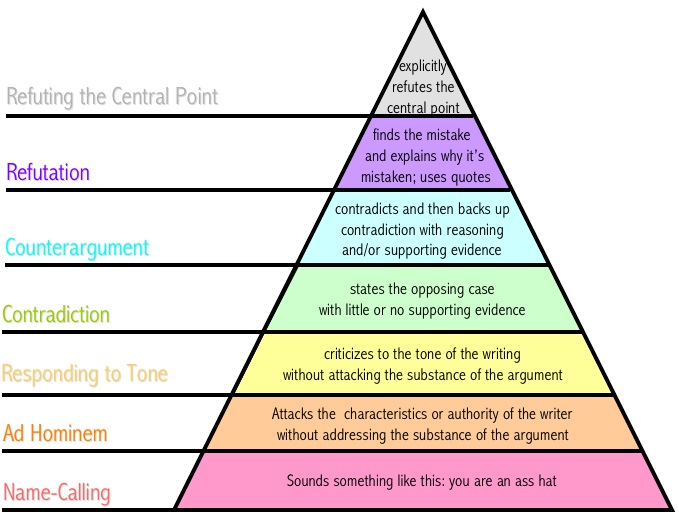
An article relevant to the above pyramid can be found at http://www.paulgraham.com/disagree.html
Note: the above image is not mine, and has been taken from http://en.wikipedia.org/wiki/File:Graham%27s_Hierarchy_of_Disagreement.jpg. Licensing is documented on that page.
An article relevant to the above pyramid can be found at http://www.paulgraham.com/disagree.html
Note: the above image is not mine, and has been taken from http://en.wikipedia.org/wiki/File:Graham%27s_Hierarchy_of_Disagreement.jpg. Licensing is documented on that page.

Wednesday, 26 October 2011
The debate over common courtesy
I have always believed that politeness is honourable, and at a minimum, a good thing to pursue: I was raised to treat others as you would want to be treated, and all my cousins have been brought up this way as well. People both in United States and United Kingdom, and in nations beyond them, appreciate small words of courtesy such as “please” and “thank you” (or the equivalent in other languages), and often despair when these terms are forgotten or perceived to be on the decline. These small words then become great gestures.
Manners are not merely limited to words: they apply to actions as well. As an example, whenever I have entered a building and there is someone right behind me, I have held the door open for them rather than let it shut behind me in their face; and the usual response is a “thank you”, a smile, or a nod, and in all the other cases no response at all. Other people have done this for me, and I am appreciative. Another example is pulling out a chair for someone so they can sit next to you (providing that is where they wanted to sit), as I have done for people and people have done for me. In every case, these actions were done in the best of faith.
Consequently, I was astounded the day I learned that there are people who deem the above behaviour to be rude, at the very least. I could not believe it when I heard that some people do consider every instance of “please” and “thank you” to be phony, or nothing more than sarcasm and/or a need for the person saying them to impress others and feel “validated”. Worse yet, in regards to holding a door open for the person right behind you, there were some who thought that anyone who did this was either a creep or had some ulterior motive, such as trying to rob the person they held the door open for of being able to do something without the aid of anyone else (this view is downright bizarre). These opinions were not limited to “please”/”thank you” or door opening: it was being applied to all acts of common courtesy. It seemed that these people were not only declining to assume good intentions on behalf of others: they were actually assuming the worst intentions possible.
Now I can certainly understand how in some cases saying “thank you” or holding a door could be considered rude. If someone says “thank you” sarcastically to a person who unintentionally inconvenienced them, that is rude; and if someone barges through a lengthy line of people just to open a door for them all, that does come across as pompous and as shouting to everyone else “Look at me! I’m polite! I opened this door for you!”…which is totally the opposite of polite. However, such occurrences are not commonplace, and the vast majority of people are genuinely polite, not trying to impress or get into the good books of others. I even agree that over-saying “please”/”thank you” and insisting on opening every door or pulling out every chair for people could be annoying, but such a person only needs to be taught to moderate their behaviour, assuming they are being genuine with their actions.
That last sentence brings me onto my final point: there are people who also equate mere courtesy and helpfulness as a sign of someone’s weakness, especially if a person is overdoing it (going back to the “validated” comment before), and try to use their manners against them. I am opposed to this, as having civility and good manners does not equal being a doormat, for a person can still be resolute and/or disagree without being obnoxious. If anything, a firm yet civil stance on something is far more commendable and preferable than accusatory or angry disagreement. I know I can say no when I have to, but I can do so politely, and firmly if it becomes necessary.
The bright side to all of this is that these negative viewpoints on common courtesy are a minority and do not appear to be catching on. In every debate I have encountered on manners, the majority of participants want them to endure and even to become even more prevalent in society: the important point is just to remember to be courteous with confidence, and not to overdo it or to come across as fake or weak.
At the present time, no one has complained to me about courtesy (just the opposite, in fact), but if and when they do, I will be sure not to end up proving one of the aforementioned points.
Wednesday, 5 October 2011
Doggy bags
I was reading this article regarding doggy bags and how people in the United Kingdom prefer not to ask for them. While my Dad has been critical of the fact that asking for doggy bags in this country can be frowned upon, I was still surprised to read exactly why that is the case when I read the article.
It appalled me to read some of the major rationales for people not wanting to ask for doggy bags. These included reasons such as "shyness about appearing to be greedy", that leftover food during the Middle Ages was given "to the poor and beggars" and is still associated with that; and finally, the wasting food being considered a "symbol of wealth and nobility throughout history".
To me, it has always made perfect sense to take home food that you do not eat at a restaurant to eat when you get back home. After all, you have paid for the food, and it saves wasting it: there should be no shame in asking to take home unused food. Restaurant portions are often large, so I would argue that it is less greedy to take home food rather than eat a huge meal in one sitting. The Middle Ages were hundreds of years ago, and I am sure there are numerous attitudes from that era that are obsolete now (in addition, leftover food in restaurants is disposed of rather than given to anyone else). As for the "wealth and nobility" reason...we do not go around assuming everybody is rich or noble, so therefore, we do not (or perhaps, should not) then assume they are poor or ungraceful just because they chose not to waste food.
Fortunately, in reading some of the comments for the article, it seems that the attitude is changing, and other people were even surprised it still exists. In all fairness, the only time we have so far requested a doggy bag here the waiter was unassuming and pleasant about us asking. If anything, he seemed quite enthusiastic about us preferring not to waste anything. I hope to see it continue and help when I can.
It appalled me to read some of the major rationales for people not wanting to ask for doggy bags. These included reasons such as "shyness about appearing to be greedy", that leftover food during the Middle Ages was given "to the poor and beggars" and is still associated with that; and finally, the wasting food being considered a "symbol of wealth and nobility throughout history".
To me, it has always made perfect sense to take home food that you do not eat at a restaurant to eat when you get back home. After all, you have paid for the food, and it saves wasting it: there should be no shame in asking to take home unused food. Restaurant portions are often large, so I would argue that it is less greedy to take home food rather than eat a huge meal in one sitting. The Middle Ages were hundreds of years ago, and I am sure there are numerous attitudes from that era that are obsolete now (in addition, leftover food in restaurants is disposed of rather than given to anyone else). As for the "wealth and nobility" reason...we do not go around assuming everybody is rich or noble, so therefore, we do not (or perhaps, should not) then assume they are poor or ungraceful just because they chose not to waste food.
Fortunately, in reading some of the comments for the article, it seems that the attitude is changing, and other people were even surprised it still exists. In all fairness, the only time we have so far requested a doggy bag here the waiter was unassuming and pleasant about us asking. If anything, he seemed quite enthusiastic about us preferring not to waste anything. I hope to see it continue and help when I can.
Subscribe to:
Posts (Atom)